Translate

Showing posts with label Unit 8. Show all posts

Tuesday, 24 February 2015

Unit 8 Assignment 2


Trade unions: 

What trade unions can you join if you work in the media and film industry?

The trade unions that you could join if you wanted to work within
the media production industry are one of the two main ones. They are BECTU (Broadcasting Entertainment Cinematograph & Theatre Union) or The Writers Guild (Of America of or Great Britain).


Why is it important to join a trade union, what can they do for you?

  • Unions take on the bad employers, and work with the good to make them better.
  • But unions are not just there when something goes wrong. We understand today's working people. Union workplaces are safer, and more likely to help employees get on with better training and development programmes. And in the best workplaces employers and unions have put behind them outdated ideas of confrontation and work together in partnership
  • Partnership employers recognise that staff morale and commitment are improved when they are treated well, have their views taken into account and enjoy job security. And in return staff take more pride in their work and are more ready to embrace the changes modern firms often need to compete.

What examples can you find of strikes or other trade union action (look for writers guild strikes in USA), 

  • The Writer's Guild of America formed a strike in 2007-2008. The strike moved to increase funding for writers in comparison to the profits for larger studios. The strike was aimed at Alliance Of Motion Picture and Television Producers (a trade Organisation interests of around 350 American Television and Film producers.) 
  • Negotiators in the strike reached an agreement in February of 2008 and a deal was approved by both guilds.
Strike over job cuts, work load and claims of bullying. The corporation is cutting over 2000 jobs over 5 years and most through voluntary redundancy. 


Why did they strike, did it impact any productions?

  • Because production ceased for all scripted television programming, hundreds or thousands of support staff were laid off by the studios.
  • Within the first week of the strike, AMPTP-member companies fired writers' assistants, production assistants, and other lower-level staffers working on shut down programs.

Freelance contracts

What does it mean to be a freelancer in the media?


  • A freelancer is someone who doesn’t work for one company full-time, but is hired by different companies for certain jobs. For example, a magazine or website will have a core team of editors who hire freelance writers to write articles, or a TV production crew might hire freelance cameramen to work on one series of programmes.
What types of freelance contract are there?

  • Freelance contracts mean working for a company for a specific time to do a job, they however are responsible for their own arrangements such as holiday or sick pay.
  • A fixed-term contract means that the job is temporary and will only be for a specific amount of time. Unlike basic free lance contracts a freelance worker is then entitled to company benefits such as employee discounts and holiday/sick pays.

What types of film or media contracts (short term/fixed term/ first refusal)
  • Freelance ^^
  • Fixed-term ^
  • Permanent-Full time-Work on a full time basis.
  • Permanent- Part time-Working part time to a contract.
  • Shift work- This means you are set to work specific hours of the day, for example 4am-3pm.
  • Office hours.
  • Salaried.
  • Irregular/anti-social hours pay.
  • On completion.
Pros and cons of freelance work. 
link to other post
Editorial Guidelines
Explain what an editorial guideline is:


  • An editorial guideline is a key foundation for the maintenance of high editorial standards in everything broadcast or produced by the BBC. They cover a range of standards including impartiality, harm and offence, accuracy, fairness, privacy and dealing with children and young people as contributors.


Look at the following link and summarise the guidelines for two or three of the subheadings
http://www.bbc.co.uk/editorialguidelines/guidelines/


Impartiality:

  • It applies for output and services like television and radio, international services, commercial magazines and via the internet.
  • The BBC go further by applying the impartiality further than just in the news, the impartiality applies to ALL subjects, the requirements varying. 
  • They treat 'Controversial subjects' with impartiality, they seek to provide a range of subject matter and varying perspectives over a suitable timeframe. They create a wide range of opinions so that no significant strand is seen as under-reflected.
  • They exercise their freedom to produce content about any subject.


Harm and Offence- Language:

  • Strong language can be one of two things it can be taken in jest but it could also cause offence through languages it all depends on the type of viewer. Their age, gender, religion and nationality could all depend on whether or not the programme or film offends a viewer. Strong language could have different impacts depending on the context of its' delivery. The producers ensure a content check over their products taking into consideration the impact that it could have on its'  audience. This helps them decide what time and channel to broadcast their product on depending on whether it is suitable for children or family viewing or whether it should be broadcasted after the watershed where strong language is more acceptable for example Celebrity Juice is aired on ITV 2 at 10pm due to strong language and sexual content.

Why is it important for a television producer to work under guidelines.

It is incredibly important for a television producer to work to guidelines for many reasons, some of which are listed below:

  1. Avoids breaking the law.
  2. Helps to avoid causing offence or showing content deemed inappropriate for a younger audience.
  3. It helps the company receive the best outcome for their programmes.
  4. It helps gain a profit, reducing the possibility of suing or getting fined which helps to avoid a failure in the company.
  5. It helps the company avoid the loss of viewers.
  6. It is very good for business.


BBFC

Who are they and what do they do?


The BBFC are the British Board of Film Classification. They are an organisation of people who grade and class films under a certain certification for viewer protection. They do this to help prevent anyone that is underage from viewing a film suitable for an older audience such as the film Gladiator -a 15 which depicts graphic scenes of violence and some strong language that a younger audience bracket could find offensive. They are the British version of the MPAA (Motion Picture Association of America).

What can you/can't you show in a PG, 12A and 15?

15 Films
What you CAN do...

  • Show strong violence and contain frequent use of strong language.
  • Show drugs and nudity.
  • Portray sexual activity and show brief scenes referencing to sexual violence.
  • Feature discriminative scenes using verbal or behavioural acts.
What you CAN NOT do...
  • Show strong detail of sexual activity or nudity.
  • Use drug content to persuade or promote drug misuse. This applies for the showing of dangerous substances.
  • Show violence that focuses on the infliction and injury of a person.
  • Use strong language which is continuously aggressive.
  • Show strong sadistic violence.
  • Show signs of dangerous behaviour in great focus nor can they encourage it to be copied.

12 Films
What you CAN do...
  • Use some strong language depending on the overall delivery.
  • Feature brief and discreet nudity.
  • Show some sexual references suitable for a younger viewer, these can often be made into an innuendo or seen with humour.
  • Violence which is not heavily graphic or detailed.
  • Use weapons so long as they are not glamorised and are used in a discreet way.
  • Show scenes of a horrific nature as long as they are not frequent or overly disturbing.
  • Show dangerous behaviour such as: Suicide.
  • Show the misuse of drugs briefly.
What you CAN NOT do...
  • Put emphasis on blood or injury due to violence.
  • Glamorise weapons such as knives or guns.
  • Present dangerous behaviour in a way that young viewers could copy.
  • Endorse anti-social behaviour.
  • Glamorise the misuse of drugs.
  • Use discriminatory language such as language that is homophobic unless it is later clearly condemned.

PG Films


What you CAN do...
  • Use mild bad language such as 'bitch' depending on the context and delivery from the actors.
  • Show violence in a mild and non-graphic light, blood can be shown but the reason for the injury can not be shown in great detail.
  • Reference to drugs but they will not be a focal point and the reference should be a clear anti-drugs educational message.
  • Include sexual references so long as they aren't detailed or frequent, something a child is unlikely to understand is usually allowed.
What you CAN NOT do...
  • Contain any content innappropriate for children.
  • Contain detailed sexual references.
  • Contain detailed violent actions or the use of extremely strong language.
  • Contain drug references or the use of drugs if an educational anti-drugs message is apparent.

Unit 8 lesson work


Pros and Cons of Freelance Working
Pros:
  • Lots of opportunity for work. 
  • You are working with a client's standard terms which could make your job easier in some ways. 
  • If you are able to, using your own contract to start negotiations, can give an impression of professionalism and also puts you at a significant advantage, not only during the project itself but also in terms of any negotiation before the contract starts and your rights once a project is over.
  • An advantage is that, where you are able to provide the services for less than the fixed price there is no legal obligation to charge any less. You know how much you will receive, no more, no less.   
  •  You get to choose who you work with (freedom) and make a lot of the creative decisions regarding what type of media products you want to make.
  • Solicitors can provide a contract you can use to decide when and how you work, your pay, responsibilities.  
  • Can take as many holidays as you want to.  
  • Career is built on relationships with your clients, improving your quality of work. 

Cons:
  • You may often find that you do not have the option to work on the basis of a contract of your own as many companies (and most agents) have standard documents that they will.
  • You'll never know when work is coming your way.   
  • You will only get a trigger payment meaning that the amount will not differ no matter how many hours you put in.
  • Because with fixed price contracts, the freelancer takes the risk of the project scope being unclear or unmanageable, a contract of this kind is only advisable where the scope. 
  • With free lance work they wouldn't get the benefits of working full time like holiday and sick pay, or maternity leave etc.  
  • You wouldn't get a bonus. 
  • Would have to get your own insurance which might take a long time and it could cost a lot.   
  • One of the risks of being an independent freelancer, rather than an employee, is that you are more likely to be sued where things go wrong.  
  • Maintaing high quality of work to keep your reputation in tact could be hard.

Tuesday, 10 February 2015

Unit 8 Prep post

What is the BBC?
how is it funded?
when did it start?

what current changes are they making to their channels or programmes?
can you find 2/3 articles on people arguing the pros and cons of the licence fee?

                                                                              
What are commercial TV channels?
How are they funded?
How do we know if a commercial channel is successful or not?
What are the highest rated programmes on ITV or channel 5


What is a meant by the term 'media conglomerate'?
Find some 'media conglomerates'?
Who are the major film production studios?
Find two or three films for one of the major studio, how much money did they make from it (box office and DVD)
What is meant by the term 'independent film'?
Can you find examples of independent film producers?
What independent films have won awards?
What are the new technological developments in the way we watch/make television and film?


What is the BBC?
BBC stands for British Broadcasting Corporation. They are a UK based international public-service broadcaster. It is the world's oldest national broadcasting organisation and it is a channel meant for supplying worldwide news and factual television shows. Often it does feature a show with a wide fanbase such as Doctor Who. It is a channel that promotes education and learning, stimulating creativity and cultural experiences. A channel to represent the UK -its nations, regions and communities in a bid to bring the UK to the world and vice versa, to deliver to the public the benefits of emerging communications, technologies and services.
How is it funded?
http://www.bbc.co.uk/annualreport/2014/executive/finances/licence_fee.html
The BBC is funded by license fee payers. They are funded by something called the BBC Trust -a governing body that make sure that the BBC deliver their mission of educating, informing and entertaining.
Total licence fee income collected increased by £16million from £3,706million to £3,722million as a result of modest household growth.
Licence fee income is adjusted for the costs of the Digital Switchover (DSO) initiative to give net licence fee income. In the year, net licence fee income increased by £70million to £3,726million. 2012/13 was the final year of DSO, although there was some limited ongoing activity this year where none was originally scheduled. Savings against DSO funding are paid over to the Government, and deducted from our income. In 2012/13 the savings amounted to £50million with a £4million carry over of cost into 2013/14.

When did it start?
The BBC started back in 1922 on the 18th October. It was founded by a group of leading wireless manufacturers including Marconi. Daily broadcasting by the BBC began in Marconi’s London studio. On November 14, 1922. John Reith, a 33-year-old Scottish engineer, was appointed General Manager of the BBC at the end of 1922.
What current changes are they making to their channels or programmes?

The current changes the BBC are making to their channels or programmes is that they are creating a newer version on BBC, a working progress based on the reviews and feedback received from their surveys. The BBC also broadcasts radio which has caused anger over the changes in radio streaming. The broadcasters have changed its' format making it inaccessible on some devices.

Pros and Cons of the license fee: 

  • It creates a pull of funds for financing.
  • It makes the corporation more productive.
  • The licence enables minorities as well to get quality information since the licence is simply required when watching or recording live TV while it is being broadcasted. This means any person can watch a quality programme that was previously recorded for free.
  • It's not economical.
  • The TV license criminalises poor people.


What are commercial TV channels?
Commercial tv channels are channels which feature advertisements during breaks and the time between each programme. The commercial channels are ones which advertise upcoming programmes, films and are paid to advertise individual products or companies. ITV, Comedy Central, E4 and Sky Movies are all examples of commercial tv channels.

How is it funded?
They are funded largely from advertising and sponsors. Small broadcasting channels are funded by local organisations or authorities.

How do we know whether a commercial tv channel is successful or not?

We know that a channel is successful if it falls under any of the categories listed below:

1. It has to be informative and memorable.
2.Can help the audience connect or relate.
3.The visuals and audio have to be aesthetically pleasing, it has to fit a particular audience.
4. It has to be simple, clear and consistent.
5. Must help to create emotional responses for the audience such as humour or guilt.
6. Can advertise other ways for viewers to see your shows and merchandise such as on the internet or buying into the product.


What are the highest rated programmes on ITV or Channel 5?

On ITV the highest rating programme is Coronation Street -credited as one of the longest running soap operas in the world and the longest running soap opera in Britain. Things such as; Doc Martin, Law and Order and Britain's Got Talent are amongst the highest rated programmes on ITV. Things such as I'm A Celebrity Get me Out Of Here are also highly rated on the ITV channel.

The highest rated programme on Channel 5 currently is Celebrity Big Brother.


What is meant by the term 'media conglomerate'?
Media Conglomerate means a media group or media institution that owns multiple companies within multi-media such as television, radio, publishing, movies and the internet.
Find some 'Media Conglomerates'
  • The Walt Disney Company
  • Time Warner
  • Viacom (this also includes Nickelodeon and Comedy Central within its' assets)
What are the major film production companies
  • Warner Bros.
  • Columbia
  • Paramount
  • Dreamworks
  • Walt Disney
  • Universal Studios
  • 20th Century Fox
  • Pixar
  • Summit Entertainment
  • Miramax Films
  • Metro Goldwyn Mayer     
Find 2 or 3 films from ONE of the major film studios. Find out how much money it made (Box office and dvd.)    
Warner Bros.
  •  F.r.i.e.n.d.s (1994-2004).
What is meant by the term independent film?
A film production  resulting in a feature film that is produced outside of the group of major film studio systems.

Independent film producer:
  • Ryan Fleck. He made the films; Half Nelson, Sugar and Mississippi Grind. He won an Independent Spirit Award.
  • Jonathan Demme also won an award at the Independent Spirit Awards for his film Rachel getting married made in 2008.
Independent films that have won awards: 
  • Pride 
  • The imitation game
  • The best exotic marigold hotel
  • The king's speech
What are the new technological developments in the way we make and watch television and film?

The biggest development to date is that we can now stream programmes and films from our laptops/computers and phones using sites such as ITV and BBC iplayer. A website called Netfiix can be used where you pay monthly to watch films and television programmes from the previous months.

Another development in the way we watch TV is that over the past few years 3D viewing and 3D TV's have been introduced to us letting us finally be able to watch in 3D from our own screens rather than paying to see a video in 3D at the cinema. 

Being able to record tv is a recent development which allows us to watch the programmes we want at later times, being able to keep programmes on for your own leisure incase you may miss your favourite programme then a sky box allows you to pre-record your favourite television shows for a time that suits you.


Tuesday, 13 January 2015

Unit 8 Assignment 4

Priority
  • Make showreel for University interviews.
  • Find examples of job adverts for producers, camera operators and production managers from different websites or newspapers. Post the link to the advert/take a screenshot. Then write underneath what you think of the job. 
  • Those applying to university -list what courses you have applied for and which courses are interesting to you. 
  • Those NOT applying to university, research online/short courses that could improve your skills and explain what is interesting about them. 
  • Write a CV for a media job.
  • SWOT -an audit of your skills to help you make plans for your future.
  • Finally write about what you want to do after college and which skills you want to develop or what you hope to achieve in the industry. Are you interested in freelance filming, more work's experience or apprenticeships?


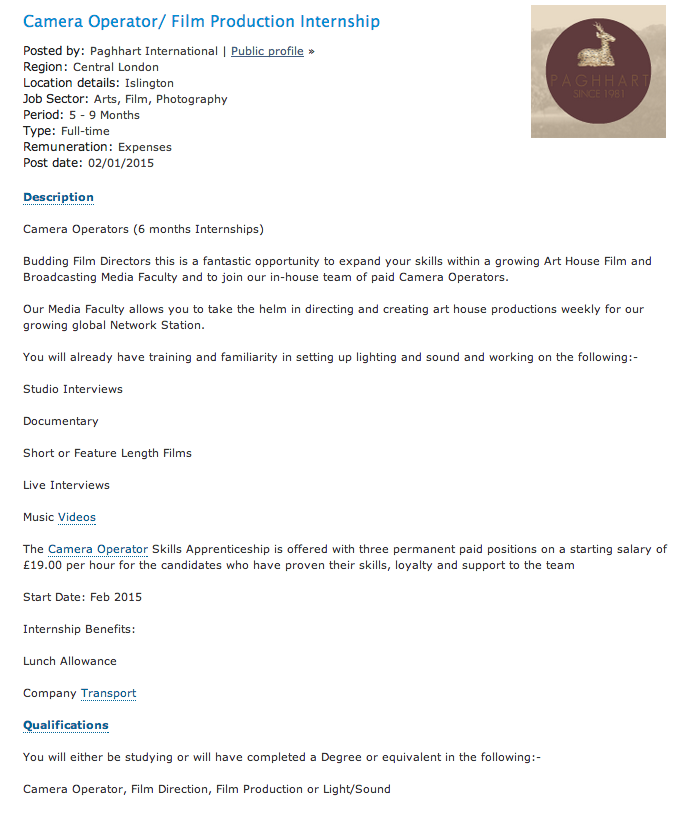
This is a job advert for a camera operator/film production internship. I would be interested in this to widen my camera skills and to gain some experience. It is based in London which would be a cool place to visit and I would be filming a variety of different types of productions. 


This is another job application for a camera operator in a studio which would be perfect as I have experience in studio production and I can operate a camera easily. 


This is a job application for a Video Production Assistant. It is a full-time job focusing on both post and pre-production work which would help to gain vital skills needed to get into the media world.


Choices for University
I have applied for 5 courses in 4 different Universities both Media production and Film production as I haven't quite decided which one I'm more interested in yet. I think I will like either course as I am really interested in the creative process of television and film. I enjoy making a production and seeing it from start to finish in all aspects of the post and pre-production process. Specifically I am interested in camera and editorial work so a course as practical as these two would be ideal for someone like me; who works best hands on engaged in practical work. 


Online courses/apprenticeships

https://apprenticeshipvacancymatchingservice.lsc.gov.uk/Navms/Forms/Vacancy/VacancyDetails.aspx?Query=85yzU3lA7VKNxi0DYmcldZVWJTqzwbFB3xUUa9mSoCChMq5zPOSOWzfnEAsI8VQSJza%2bjx4ddJ2QqcDqjyeUVhp00gyosgcVptJVF0abnjj6ssfpcELkI2Al4E7vviULp6F5jvWxPaXJUEVst6BymLJN89UsZI1X7wjV78s32n2XS0BWRitYhbRMVSiAU4Lj0R9g9E861Ki0TAGUMhx8bwiL7aTNMstRqov6odQuBrqIlEExxZoPHCy0p4q%2fWh2%2fiKpmi%2bQCbY%2bTafqgvfas1A%3d%3d

https://apprenticeshipvacancymatchingservice.lsc.gov.uk/Navms/Forms/Vacancy/VacancyDetails.aspx?Query=48feNCXsvDhmbYlA5885evpadbmEs446r2lFvpT%2fzgYA5oCFFDQRyXlcPYhuCrsG%2fv0ZyT18JGy34Nj1lf3cirbSysnLkcuFtDhrzu44B0DzYI%2fpOmOppcAMxwMPLT4tgnNMI%2frAGh9%2bib7TpbNCG2rxqR3kg6D2Q14XxCzstQtooDirV7pm%2bKwQjG4Jr0FrrhbUXPcfgCCA2Zlvra3rmlh1cQfQhPCJN22wbmSAWvO2ODzrGwVLdn4MaBiDv2CXXJkGFRoiRgOocm7BaOJDjA%3d%3d

http://www.filmapprenticeship.com/film_school_video_production_education_multimedia_instruction_mentor_apprentice/film_school_video_production_education_multimedia_instruction_mentor_apprentice.html
                                                                                                                                                           
https://docs.google.com/document/d/1BzVt9RGKXAwpkiuS_XeWG8ur4R9G-YtXtGK2eEft8X4/edit?usp=sharing


SWOT:

Strengths:
  • I am hard-working and I aways work to the best of my ability. 
  •  I am a good organiser meaning I can plan a structure. 
  •  I am consistent. 
  •  I am flexible and adaptable meaning I can adapt my ideas around a variety of different briefs.
Weaknesses:
  • Drawing. 
  •  Can work myself too hard -perfectionist. 
  • I'm not assertive or direct -struggle when giving people instructions or trying to control situations.  
  •  Poor public speaking skills. 
  • Easily stressed.  
  •  Can get distracted easily -tend to be somewhat of a procrastinator unless I focus which is usually focusing too hard causing more stress.
Opportunities:
  • Unit 27 (Making a Documentary) will educate me on factual programming and I will find different topics to base it on.   
  • Unit 21 (Camera Workshops/Editing Refresher) will enhance my technical skills by showing me different techniques, hints and tips to improve my skills, improving my knowledge by giving me constant practice and reminders.  
  • University courses -media production will give me all round knowledge of the media both theoretical and technical, enhancing my skills. 
  • University course- film production will give me a more focused knowledge learning about film production specifically rather than a broader range of knowledge.
Threats: 
  • Money could be a problem seeing as though I don't have it which would limit my skills as my technology would be quite limited which could make my productions look amateur.   
  • Pressure to succeed could cloud my judgement and cause a lack of focus. 
  • Anxiety and depression can lead to stress and lack of motivation, making me work slower or faster depending on what mental state I'm in. 
  •  Family pressure to go to university, not to disappoint the family, to earn money. 
                                                                                                                                                           
After college I'm not really sure what I would like to do exactly. University is an option which could be explored, having applied for a UCAS application I may end up doing a degree. However an apprenticeship or volunteering opportunities could benefit me equally as well giving me practical skills over the theory work. Freelance filming could be interesting but I'm not really sure how I'd go about that, I'd need a lot of money that I don't have and equipment which again I don't have. In the industry I hope to make something different, something meaningful about important issues to give people information on things that they aren't always taught in schools such as: mental health issues or bullying which effects a lot of people but isn't addressed enough in schools.